
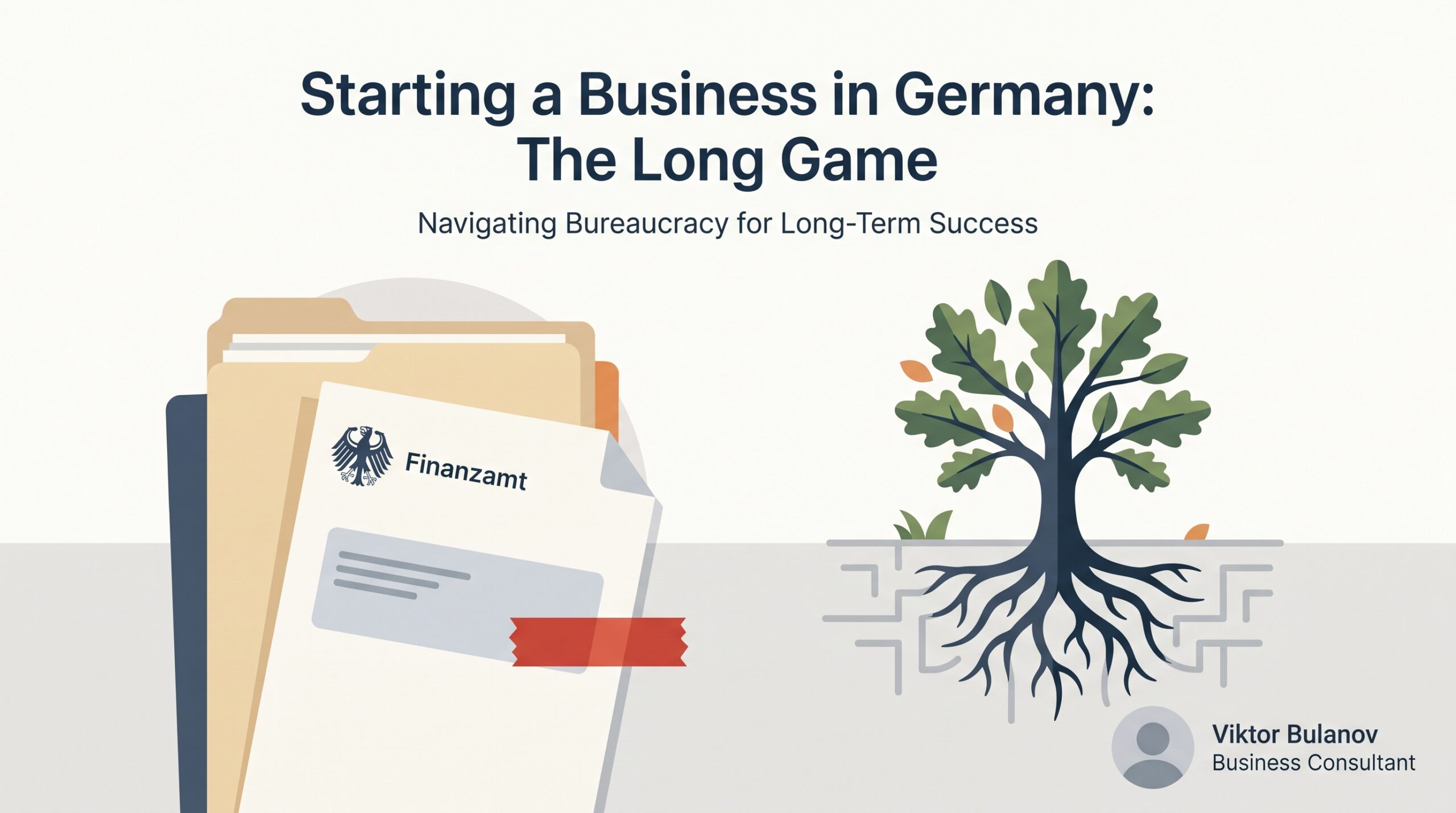
If you’ve ever tried starting a business in Germany, you know the feeling. You’re sitting in line at the Gewerbeamt with a printed form, and the person next to you is filling out their paperwork with a pen — yes, a pen, in 2026. Three weeks later, a letter arrives. A physical, paper letter. Asking you to submit one more document.
German bureaucracy isn’t a myth or an exaggerated expat complaint. It’s real. Opening a business bank account can take a month. Registering a company can take weeks, if you’re lucky. And if you decide to hire your first employee, welcome to German labor law, where firing someone is harder than getting married and divorced combined.
On top of that, there’s the language barrier. Even if your German is solid, legal and tax letters read as if they were written specifically to make you stop reading. Without a Steuerberater (tax advisor), you’re pretty much lost — and that’s another expense from day one, possibly before you’ve landed a single client.
The startup ecosystem isn’t a fairytale for everyone either. Sure, Berlin has its scene and its venture money, but outside a couple of cities, investors are far more conservative than in London or San Francisco. A German investor is more likely to ask about your unit economics on slide three than get swept up by a nice growth story.
It sounds like nothing but downsides. But here’s the thing.
Friction acts as a filter
All this slowness and red tape works as a kind of natural selection. Starting a company on a whim and shutting it down six months later is simply harder here — which means the businesses that actually reach the market tend to be the ones run by people who are serious about it. A German B2B client who’s worked with the same supplier for years does so because trust here builds slowly — but once it’s built, it rarely falls apart. Contracts get honored. Nobody disappears after signing a deal.
“Made in Germany” isn’t just a marketing line
The regulations, certifications, and quality standards that drive you up the wall at the start later become your competitive edge. A product that survives the German bureaucratic grinder is automatically taken more seriously in many markets — from the Middle East to Eastern Europe. It’s a kind of free quality seal you can’t buy with any marketing budget.
A safety net lowers personal risk
One of a founder’s biggest fears is: what if it doesn’t work out. In Germany, even if your business fails, you’re still covered by a healthcare system that won’t abandon you, and there’s a relatively clear path back into the job market. That changes the whole psychology of risk-taking. People are more willing to try, knowing that failure won’t be a catastrophe.
Slow growth is sometimes healthier growth
The “grow at any cost” culture common in American startups doesn’t really work here — and honestly, thank god. The German market tends to reward a company that spends ten years steadily solving one problem more than one that grew tenfold in two years and then burned out. For some, that’s boring. For anyone who wants to build a business meant to last decades rather than chase a Series B round, it’s an advantage.
So is it worth starting a business in Germany?
There’s no single answer, and anyone who tells you otherwise has either never started one here or is selling a course on “how to easily start a business in Germany.” If you need speed, flexibility, and a market willing to experiment — there are easier countries out there. But if you’re playing the long game, value predictability, and are willing to spend the first few months fighting paperwork to build a solid foundation, Germany might turn out to be a surprisingly good place.
Just be ready: your first letter from the Finanzamt will arrive by mail. Paper mail.
A specific situation — legal form, bank account, licences, tax registration — is case-by-case work: services and pricing.